
A question often raised concerning ISIS is, “Why in the
world would young people in the West would want to join them?” There are, of
course, a rash of opinions on the topic, but those of us who want something more
substantial than that will need to read and think, and then think some more. I
am convinced there is no simple answer but rather a confluence of social and
personal pressures, yearnings, attractions, and dislikes that make the choice
feel not merely possible but necessary.
To try to comprehend this, we will need to read and think
about both the culture of the West and the world of Islamic life and thought,
including the version of Islam promoted by jihadists. A careful consideration
of both sides of the issue is required. Why are young adults leaving the one to
join the other? There is at work forces of both repulsion and attraction.
Perhaps you have already seen these two articles, but I
commend them to you as helpful in our attempts to truly understand and respond
Christianly to our world.
The first is “What ISIS Really Wants” by Graeme Wood in The Atlantic (March 2015)—it can be read
here.
The second is “In Defense of Islam” by Ross Douthat in the
New York Times (February 18, 2015)—it can be read here.
And as always, I would love to read your comments about
either/both pieces.

In “Among the Disrupted,” the cover essay for the New York Times Book Review (January 18,
2015) Leon Wieseltier laments how devices are often valued over books,
technology seems ascendant over the humanities, hunger for instant information
has replaced the long search for wisdom, and the meaning of humanity has been
reduced to the mechanistic. All worthy concerns, I would say, even if you or I
would parse things differently in places from Mr. Wieseltier.
You can read his essay here.
And to get you started pondering the ideas Wieseltier
raises, here are few quotes from “Among the Disrupted”:
“Journalistic
institutions slowly transform themselves into silent sweatshops in which words
cannot wait for thoughts, and first responses are promoted into best responses,
and patience is a professional liability. As the frequency of expression grows,
the force of expression diminishes: Digital expectations of alacrity and
terseness confer the highest prestige upon the twittering cacophony of
one-liners and promotional announcements. It was always the case that all thing
must pass, but this is ridiculous.”
“The
distinction between knowledge and information is a thing of the past, and there
is no greater disgrace than to be a thing of the past.”

“Aside from
issues of life and death, there is no more urgent task for American
intellectuals and writers than to think critically about the salience, even the
tyranny, of technology in individual and collective life.”
“The
processing of information is not the highest aim to which the human spirit can
aspire, and neither is competitiveness in a global economy. The character of
our society cannot be determined by engineers.”
“Every
technology is used before it is completely understood. There is always a lag
between an innovation and the apprehension of its consequences. We are living
in that lag, and it is a right time to keep our heads and reflect. We have much
to gain and much to lose. In the media, for example, the general inebriation
about the multiplicity of platforms has distracted many people from the scruple
that questions of quality on the new platforms should be no different from
questions of quality on the old platforms. Otherwise a quantitative expansion
will result in a qualitative contraction. The new devices do not in themselves
authorize a revision of the standards of evidence and argument and style that
we championed in the old devices.”
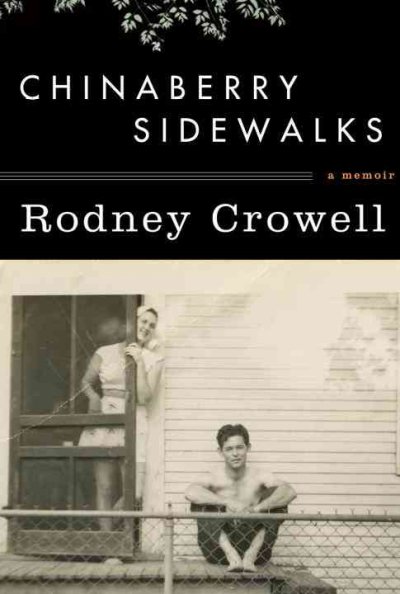
Both Keith
Richards and Rodney Crowell have spent a lifetime in music, and both can look
back on performing and recording legacies that have served to touch the
imaginations of numerous fans. It’s true that Crowell has never achieved the
fame of Richards and the Rolling Stones, but art is measured in reach as much
as it is depth, and here Crowell has the edge. Both men know firsthand
something of the devastation wrought by alcohol and drugs, and both can look
back on relationships that were thrown away selfishly and of others that
brought sweet rumors of grace.
I read both
books because I respect both men as musicians. I like the music of Crowell far
more than that of Richards, but recognize that both men have honed their craft over
many decades of dedicated practice, touring, and recording. Their styles are
different, of course, very different, but both are part of the cultural world in
which I grew up and still live. Both men are still active, making music and
thus helping to both shape and reflect the culture in which I live and seek to
understand.
Yet, the
books are very different. Keith Richard’s Life
is massive and detailed, full of gossip and facts, reflections and anecdotes.
Rodney Crowell’s Chinaberry Sidewalks
is more modest, a childhood memoir of a home in a poor Texas community with an
alcoholic, violent father and an unstable mother given to Pentecostal fervor.
But there is a deeper and more vital difference as well. Richard’s reflections
reek of self-satisfied self-centeredness, and seldom is grief or regret expressed
over the excesses in which he indulged. Crowell’s story, in contrast, is imbued
with a quiet honesty tinged with forgiveness, the thoughtfulness of a man who
tells his story, warts and all, but does not think that all is fine simply
because it is his story.

I did not
carefully read every word of Life,
but scanned some sections because I was weary of the tone. When I finished Chinaberry Sidewalks, on the other hand,
I purchased tickets to go see Crowell in concert—it was a wonderful evening. Recently
Crowell has been collaborating with poet Mary Karr (I recommend the CD Kin, with Karr’s lyrics and Crowell’s
music and performance), after being in Emmy Lou Harris’ band since 1975.
One thing
is certain: blatant excess does not necessarily mean an artist can not achieve
excellence, and unless Richards has sources of which I am unaware, his memory
is both remarkable and far better than mine. Those with a special interest in
the Rolling Stones and their very long career at the top of the charts in
popular music will want to read Life.
Richards reflects on numerous concerts and recording sessions in the book in
incredible detail.
Listening
to people’s stories is important if we want to hear something that gets past
the surface details. Crowell uses the details of his childhood to tell a deeper
story, while Richards amazes us with gossipy trivia in what seems to me to be
primarily an ongoing exercise in self-aggrandizement. If you doubt that an
artists’ deepest convictions and values—the world and life view that resides in
their heart of hearts—shapes their music and their posture in life, read these
two books, and then listen to some of Richards’ and Crowell’s music.
Life by Keith
Richards with James Fox (New York, NY: Little, Brown and Company; 2010) 547
pages + index.
Chinaberry Sidewalks:
a memoir by Rodney Crowell (New York, NY: Alfred Knopf; 2011) 259 pages.

In the years since his death in 1984 it’s been interesting
to watch and listen as people have claimed, explicitly or implicitly, to be
carrying on the legacy of Francis Schaeffer.
I am not including here those who continue to serve as
Workers in L’Abri Fellowship, the study communities that grew out of the
conversations and hospitality the Schaeffers offered a growing number of young
adults who trekked to their chalet in Switzerland beginning in the mid-fifties.
The work of L’Abri continues, and though the shape of that work in the various
centers in Europe, America, and Asia has not remained static, it consciously
and intentionally stands on the shoulders of Edith and Francis who walked that
path originally. As someone who honors Francis Schaeffer as a mentor, I happily
remember him as a teacher who invested untold hours in listening to my
questions and discussing the world with its trends and ideas that help shape
lives and cultures. I think—I hope—I learned from him, and want to try to
faithfully put into practice the best that I learned from and saw in him. I
have no illusions, on the other hand, of continuing Schaeffer’s legacy—that
role is best assumed not by me but by those in L’Abri and by Jerram Barrs, Resident
Scholar of the Francis A. Schaeffer Institute at Covenant Theological Seminary
in St Louis.
What I’ve found interesting are people who are outside
L’Abri but who invoke the Schaeffer name as a sort of imprimatur to provide
gravitas for their own ideas and work. The ones I'm referring to here are found
on the conservative or right wing of the American political continuum, and are active
in promoting what’s come to be called the “culture war.”
And I must say that as I have watched and listened as people
active in conservative culture war politics claim Schaeffer’s legacy, I am not
impressed. Here are three reasons.
1. Culture wars and worldviews. When James Davison Hunter
published Culture Wars in 1992 he was
reporting on a sociological reality, not issuing a call to political activism.
Hunter is a careful observer of American society and understood that the divisions
over economic, social, religious, and political issues arise primarily not due
to pragmatic reasons or because people are uninformed, but because the American
people hold widely differing worldviews that inform their views on the issues.
This insight should have helped Christians concerned for truth and culture to
remember what Schaeffer had insisted on all along, namely that everyone holds a
world and life view, that challenging another’s worldview must be approached
with compassion in an intentionally safe community where people love and care
for one another, and that though the history of ideas is crucial for discussing
worldviews, worldviews are far more than simply ideas that can be debated.
Instead, conservative culture warriors claiming Schaeffer’s legacy have done
the opposite: they ratcheted up their rhetoric in the public square, declared
war to take back the culture, and started attacking liberals, secularists,
environmentalists, and anyone else who dared question their conservative
ideology and agenda as the ones against whom the worldview war must be fought.
Just the opposite of what Schaeffer stood for, demonstrated, and taught.
2. Faithful citizenship and politicizing life. Throughout his
life Schaeffer argued that because Christ is Lord of all, Christianity has
something substantial to say into every sphere of life and reality. This
included politics, so that unlike the earlier withdrawal from involvement in
politics led by evangelical leaders after the Second Great awakening,
Christians could and should see the call to politics as a legitimate vocation
and fulfill their duty as citizens being motivated to seek the common good for
all. Instead, conservative culture warriors have (along with more progressive
believers) politicized life, making politics the central animating focus for
seeking to change the world. One symptom of politicization is when people judge
another’s moral integrity on the basis of their voting or party affiliation. As
James Davison Hunter puts it in his latest book, To Change the World (2010), “the public has been conflated with the
political” (p. 168). This in the end not only dismisses the richly nuanced nature
of human existence and human society by reducing all spheres of life to the
political, it is a practical denial of Christ’s Lordship. When Schaeffer called
for Christians to be faithful as citizens he did so while calling them to be
faithful across all of life and culture, and from that perspective only a tiny
slice is in any way even remotely connected to politics. Another symptom of
politicization is when the discussion of every societal or human problem rather
quickly resolves into a discussion of politics. The political sphere of life
has dignity and is significant, but in reality its scope is extremely limited.

3. Conservative ideology and caring for the earth. It is not
surprising that the book by Schaeffer that conservative culture warriors seldom
quote is one of the most significant if someone is to claim his legacy. Because
Schaeffer’s thinking and living was informed by Scripture rather than by political
ideology he wrote Pollution and the Death
of Man (1972). The book is made up of two themes. First, Schaeffer refutes
the charge that the Christian view of creation is to blame for the ecological
degradation found in the modern West by elevating the value of the “spiritual”
over the “physical.” And second, Schaeffer goes on to show how Christians must
care for the earth because the earth is the Lord’s, we are stewards, and the
physical matters because God said it was good. The physical world matters not
just a little, but a great deal. How great? Schaeffer gives a specific. “One
does not deface things simply to deface them. One would not willingly with no
reason deface a rock. After all, the rock has a God-given right to be a rock as
He made it. If you must move the rock in order to build the foundation of a
house, then, by all means, move it. But on a walk in the woods do not strip the
moss from it for no reason and leave it to lie by the side and die. Even the
moss has a right to live. It is equal with man as a creature of God.” Instead,
conservative culture warriors have adopted an ideology that is broadly
understood to be cynical about scientific research, to be insensitive to caring
for the earth, and is unwilling to act on the obvious truth that environmental
degradation is a cost that must be factored into plans for economic
development. Schaeffer was correct to argue in Pollution and the Death of Man against the charge that the biblical
understanding of creation leads to an elevation of the “spiritual” at
the expense of the physical. Unfortunately, the charge can be made today that conservative
culture warriors claiming Schaeffer’s legacy have elevated the political over
the biblical at the expense of caring for the earth as God’s stewards, even at
cost. My goodness, I have spoken with environmentalists less radical than
Schaeffer—notice he compared human beings to moss and a rock, and insisted they
have, as creatures, equal value.
I’ll let Schaeffer have the final word:
“As far as living is concerned,
we are on the knife-edge of time. What will matter is our relationship to the
Lord Jesus, individually and then corporately, at this existential moment. What
counts, as [people] look upon us... is whether we are exhibiting God and his
character, now. The Christian position is not static, but living” [The God
Who is There (p. 155)].

Every other year Calvin College hosts a conference brimming
with plenaries, breakout sessions, and concerts that explores the dynamic
intersection of music and faith, culture and gospel. This is not your normal “Christian music” event,
and if you are looking for that, two things come to mind. First, why in the
world would you look for that? And second, go to The Festival of Faith & Music instead.
This year the Festival is scheduled for April 7-9, 2011 on
the campus of Calvin College, Grand Rapids, MI.
Worth noting: if people get a group of 4 or more to register
together, they get a discount ($75 instead of $125), which is a great deal.
Check it out online here (http://www.calvin.edu/go/ffm).
Speakers and performers this year include:
Tom Beaudoin (professor of theology at Fordham University) and
director of the Rock and Theology Project, gathering together academic
theologians who are also practicing rock musicians and fans to explore the
traffic between rock cultures and theological cultures, and the implications of
these interchanges for faith and culture today.
David Dark, author of The
Sacredness of Questioning Everything and Everyday Apocalypse
 : The Sacred Revealed in Radiohead, The Simpsons and
Other Pop Culture Icons.
: The Sacred Revealed in Radiohead, The Simpsons and
Other Pop Culture Icons.
and Everyday Apocalypse: The Sacred Revealed in Radiohead, The Simpsons and
Other Pop Culture Icons.
Jon Foreman, lead singer, guitarist, and songwriter of the band
Switchfoot.
David Fuentes, Professor of Composition and Theory at Calvin
College, and author Figuring Out Melody (available on his web page) is a step-by-step manual for composition.
Ken Heffner is the director of Student Activities at Calvin
College and the director of the Festival of Faith & Music. Among others,
the concert season he founded at Calvin has featured Dave Matthews Band, the
Indigo Girls, Lupe Fiaso, Joanna Newsom, Iron and Wine, Sufjan Stevens, Mavis
Staples and the Decemberists.
Sarah Masen, musician and songwriter (www.sarahmasen.com).
Jessica Misener, music critic and journalist for Relevant Magazine.
Mwenda Ntarangwi, cultural anthropologist and author of East African Hip Hop : Youth Culture and Globalization
(Illinois, 2009).
: Youth Culture and Globalization
(Illinois, 2009).
: Youth Culture and Globalization
(Illinois, 2009).
Daniel White Hodge, a hip hop scholar, focuses on race
relations, film, cultural trends and spirituality and has written, The Soul Of Hip Hop : Rims, Timbs, & The
Soul of A Culture.
: Rims, Timbs, & The
Soul of A Culture.
: Rims, Timbs, & The
Soul of A Culture.
Gregory Wolfe is Writer in Residence at Seattle Pacific
University and the founder and editor of Image.
Shara Worden studied opera at the University of North Texas,
and after moving to New York, has focused on arranging and composition.
I need your help.

I am writing a book about living in an increasingly
pluralistic world; about what Christian faithfulness looks like in such a
situation. I want my thinking—and writing—to resonate with life as we actually
find ourselves living it, to be authentic, in other words. So I would love to
have your reflections on an aspect of pluralism that can be unsettling. I’d
like to know whether you have experienced it and if you are willing, how you
respond to it. I’m not looking for a worked out thesis but simple honesty.
Here is what I’d love to have you respond to: A friend of
mine, Greg Grooms of Hill House in Austin, TX was commenting on pluralism and
said something like this:
Not only are there a
variety of non-Christian ideas, convictions, and worldviews, some of these
beliefs and values can be closer to us—to our beliefs and values as Christians—than
they are to each other. And some may even be closer to us—to our beliefs and
values—than that held and practiced by many if not most of our fellow
Christians.
What do you think?
I’d love for you to reflect on questions like these, to the
extent you are willing:
Have you experienced this—would you be willing to share a few details?
How did/does it make you feel—what was/is your emotional response?
How did/do you respond? (Whether good or bad, thoughtful or instinctive,
short answer or long, or even a rant…)
And if you are a non-Christian, of course you may have experienced it as well, and I'd love to hear your reflections as well.
I can hardly wait to read your comments. And thank you.

Being
discerning, to think and live critically in light of our deepest faith
commitments—a theme that is at the heart of my sense of calling—allows Christians
to apply the revelation of Scripture to life even when we need to respond to
something that the Bible does not specifically address.
Our
lives are a story, and we often speak in such terms, when new friends tell us
the story of their lives. We live in a greater story, a story in history in
which we play only a small part but that affects our stories, the details,
twists and turns, and outcomes. Finding meaning and a sense of direction in
life requires that we locate our individual story in some larger story that
will give it significance. This is why religious traditions always involve
narratives, or myths that give a wider perspective on things. For the Christian
the Scriptures provide us with a story—really, The Story—in four sections:
Creation, Fall, Redemption and Restoration.

Wheaton
theologian Kevin Vanhoozer takes the story metaphor one step further. Instead
of imagining faithfulness as being in a story, imagine it as being in a play, a
drama telling that story enacted on a stage before the watching world. Think of
the canon of the Scriptures as a script, he says, in which we have a part to
play. In this vision of things, the Christian story, our beliefs and central
doctrines becomes the contours of a worldview that shapes our minds, hearts and
imaginations so that we don’t just follow the script, but actually inhabit it.
Vanhoozer’s
metaphor won’t make sense if the play we imagine is of the junior high variety
in which bored players mechanically go through their paces or some amateur
production in which the actors are enthusiastic but still are limited to
reproducing the script to the best of their ability. Instead imagine a
production in which actors are so immersed in the script that they seem to
become their character in a way that only those whose true vocation is the theater
can achieve. This sort of actor becomes
the character they are playing and the plot becomes
their story.
This
provides a basis on which the players can go beyond the script without
departing from it. The unfolding biblical Story, Vanhoozer argues, “is a guide
for the church’s scripted yet spirited gospel performances… The Holy Spirit is
both author of the script and the one who guides the church’s contemporary
performance—its improvisatory variations—on the script.” When a line is dropped
or some unexpected twist suddenly occurs during a play accomplished actors
improvise not by making something up, but by remaining in character so
profoundly that what unfolds on stage would be in the script had the writer
addressed such an event. Christian faithfulness does not entail straining to
locate proof texts that apply to our situation, or generating legalisms to
generate conformity. Instead, faithfulness means being so steeped in God’s word
that our reactions and responses are shaped by its truth. “This is what the
canon, the church’s Scripture and the Christian’s script, ultimately provides:
the ability to make judgments about the true, the good, and the beautiful that
are fit ‘in Christ’.”
Improvisation
in this view does not imply moving beyond the Scriptures but rather a display
of holy spirited wisdom in fleshing out God’s revelation even when our
circumstances do not match any specific biblical text. Rather than moving beyond, the description of moving more deeply into would seem more
appropriate. This is what Daniel and other exiles were required to do when they
found themselves in Babylon. The Mosaic law was specific about worshipping any
god other than God (compare Daniel 3 and Exodus 20:1-4), but offered no
particular guidance on how (to choose one example) to respond to being given
pagan names (Daniel 1:7). In one case they objected, even though it put their
lives at risk, in the other no objection is noted in the historic record, and
in both they are divinely noted illustrations of faithfulness. “It is a
matter,” Vanhoozer says, “of living well with others in the world to God’s
glory.” The exiles properly refused to bow before false gods but also properly
did not object when Babylonians acted as Babylonians do, in ways consistent
with their own pagan culture, beliefs, and values.

Like
the exiles in Babylon we find ourselves in uncharted territory as the culture
in which we are ordained to live becomes more pluralistic, post-Christian, and
globalized. Uncharted in terms of proof-texts, that is, but not unscripted—and
just as the exiles in Babylon could know they had not been abandoned by God, so
we can live in the assurance that the love of God as expressed in grace is
unchanged, and will remain so, world without end.
Note: A longer version of this piece appears in Critique #3-2010 published by Ransom Fellowship.
Sources: John
R. W. Stott, Involvement Volume I: Being a Responsible Christian in a
Non-Christian Society, (Old Tappan, NJ: Fleming H. Revell, 1985), 61; Kevin
J. Vanhoozer, The Drama of Doctrine : A
Canonical Linguistic Approach to Christian Theology (Louisville, KY:
Westminster John Knox Press, 2005), xii, 102, 109, 308, 366.
: A
Canonical Linguistic Approach to Christian Theology (Louisville, KY:
Westminster John Knox Press, 2005), xii, 102, 109, 308, 366.
: A
Canonical Linguistic Approach to Christian Theology (Louisville, KY:
Westminster John Knox Press, 2005), xii, 102, 109, 308, 366.

In a new book edited by Peter L. Berger, James Davison
Hunter reflects on the fact that rhetoric aside, both relativism and
fundamentalism are “weak cultures” when they animate people and shape their
beliefs and values in a society.
On the face of it,
relativism is the foundation for a weak culture. In the case of western Europe
and North America where the structural dynamics that underwrite relativism are
most pervasive, all aspects of the dominant normative order are fragmented and
the plausibility structures that frame any particular subculture are fragile.
It is no wonder that in these societies one finds little by way of strongly
held beliefs, values, ideals, practices, and rituals shared in common. Relativism
itself, whether a philosophy or a working set of assumptions for the average
person, has no ethical coherence and it provides no language or vision for a
common future and therefore it offers few if any resources for collective
action.
By contrast,
fundamentalism asserts itself as a strong culture. However implausible,
unattractive, or impractical it is to most people, fundamentalism (in its
variety) is rooted in a strong epistemology and therefore, in a limited way, it
operates with a strong ontology, coherent ethics, and clear teleology. It is
true that against the ubiquity and force of the global economy and its
torrential flows of information, entertainment, and technology, fundamentalism
is institutionally weak. Yet the culture of fundamentalism provides a strong
normative framework for collective action.
But even as a
normative order, the various fundamentalisms are far weaker than they appear.
The weakness of fundamentalism is betrayed by its essentially negational
character, a character that takes form in its highly cultivated resentments.
What is also common to all fundamentalisms, in other words, is an identity
rooted in a narrative of injury in which the faithful understand themselves to
be victims. This narrative is reinforced by the very real external threats of
secularism (and relativism) carried by globalization, by liberal parties within
their own faith tradition, and by other hostile religions. In this light,
resentment provides a distraction from the questions and doubts forced upon
everyone to some degree by the modern world. For the fundamentalist, it is far
easier to target enemies outside of the tradition than to seek answers within
it. This is not to say that fundamentalism provides no answers to the important
questions of life or that there is no genuine faith that animates the
believers. Neither statement could be made categorically. What is true is that
the narrative of injury and the hostility it generates increasingly become the
dominant expression of the faith and the primary sources of collective identity
for the most committed believers.
Another, perhaps more
important, manifestation of the weakness of fundamentalism as a culture is the
flip side of resentment. As a culture, fundamentalism in its variety is marked
by an incapacity to make strong and constructive affirmations. As Josef Pieper
has argued, healthy and sustainable cultures make space for leisure,
philosophical reflection, scientific and intellectual mastery, and artistic and
literary expression, among other things. In a vital culture, individuals,
families, and communities are animated by the idea of bettering themselves. The
genius of all the great world religions has been their capacity to transcend
the limitations of time, environment, and human circumstance by providing
resources to imagine the horizons of progress and improvement. With
fundamentalism, however, there is an inverse relationship between militancy and
intellectual, spiritual, and aesthetic vitality. Fundamentalism can point to no
creative achievements, it offers no constructive proposals for the everyday
problems that trouble most people, and it provides no vital solutions to the
problems of pluralism and change. Indeed, just the opposite.
What this means is
that it is not just contemporary relativism that is nihilistic in character. In
a different way and for different reasons, fundamentalism is every bit as
nihilistic. The bitter irony for the fundamentalist is that in the name of
resisting the internal deterioration of faith and the corruption of the world
around them, fundamentalists unwittingly embrace one of the most corrosive
aspects of this deterioration, namely, the will to power. This is one more way
in which fundamentalism expresses its intrinsically postmodern character. It
embraces a Nietzschean Zeitgeist
that, in effect, reduces all social relations (especially with non-believers)
to power relations.
Excerpted from: Between Relativism and Fundamentalism :
Religious resources for a middle position edited by Peter L. Berger (Grand Rapids,
MI: Eerdmans Publishing; 2010) pp. 32-33.
:
Religious resources for a middle position edited by Peter L. Berger (Grand Rapids,
MI: Eerdmans Publishing; 2010) pp. 32-33.
:
Religious resources for a middle position edited by Peter L. Berger (Grand Rapids,
MI: Eerdmans Publishing; 2010) pp. 32-33.
Peter L. Berger is senior research fellow at the Institute
on Culture, Religion and World Affairs at Boston University.
James Davison Hunter teaches sociology at the University of
Virginia.