The world
remains a troubled, and troubling place. Wars have proliferated into seemingly
never ending skirmishes in numerous places around the globe, and the process of
globalization means the West will be party to them even if we believe we are a
force for goodness and freedom in a world torn apart by intolerance, greed,
religious, nationalist and ethnic fervor, and old grievances. Too much is at
stake for us to remain aloof, whether what is at stake is oil, or international
terrorism, or human dignity. Most of the time I hear of all this in three forms:
brief videos or photos that capture single decontextualized moments in the
larger conflict, news stories that try to give some impression of what is
happening, and horrific statistics of numbers killed, displaced, or maimed.
One
perspective that is difficult to achieve is the view on the ground, the way
things look as events unfold not to policy makers, or military commanders, or
media correspondents but to the individuals taking part in the action. I
sometimes assume I can imagine that perspective, but that is an illusion. Once
the conflict is underway, decisions must be made not with careful reflection
but in the moment, and all the moments during armed conflict are fiercely unforgiving.
Hesitate to shoot, and you might be shot, but pulling the trigger might result
in some tragedy far beyond the death of the enemy combatant who has you in his
sites. Brokenness is far messier than we usually admit, and armed conflict is
the messiest of all. This does not mean we give up on trying to understand, but
it does mean our conclusions should reflect a measure of nuance that is far
deeper than what we hear from pundits, talk show hosts, culture warriors, and
partisan political debates.
Trying to
gain some sense of the view on the ground—though it will always remain badly incomplete—can
help in this process. Here are two books that help provide that.

Under Fire: The Untold Story of the Attack in Benghazi (Fred Burton
& Samuel Katz, 2013)
On September
11, 2012, armed men stormed the American diplomatic mission compound in
Benghazi, Libya. When the attack was over at dawn the next day, the American
ambassador to Libya, Christopher Stevens, the Information Officer, Sean Smith,
and two CIA agents, Tyrone Woods and Glen Doherty were dead. Several of the
Diplomatic Security (DS) agents, whose task is to provide protection for the
Ambassador (and other diplomats) were badly injured, and all were exhausted and
dispirited over the fact that on their watch such a tragedy unfolded. Under Fire is their story, told from the
perspective of the DS agents on the ground in Benghazi.
One of the
authors of Under Fire, Fred Burton,
is a former State Department counterterrorism deputy chief and DS agent. The
other, Samuel Katz, is an expert on Middle East security and international
terrorism.
The
linchpin of America’s ability to lead the world, from around the world, even in
locations and war zones where the intelligence community drives the diplomatic
engine, is the courage, dedication, and sacrifice of the men and women of the
Diplomatic Security Service who find themselves in harm’s way, driving a follow
car or maintaining security programs at fortresslike embassies, and those that
are not fortresses, in locations that few Americans would be able to locate on
a map. American diplomatic interests—and the realities of day-to-day
expeditionary diplomacy—could never be protected if this intrepid force of
federal agents were not on post and on guard. The true story of the Benghazi
attack is not one of failure or cover-up. The true story of Benghazi is that
men and women volunteer to place themselves between a bullet or a bomb and
America's diplomats and interests inside the crosshairs, inside the most
dangerous and volatile locations in the world. [p. 264]
Under Fire is not all you will need to
read about the Benghazi attack. Numerous hearings have been held and reports
issued in an attempt to discover what happened and why, and who, if anyone is
to blame. Some of this involves an honest effort to find the truth, while much
is little more than partisan posturing. Under
Fire does not try to sort all that out, but rather tells the story of what
the attack was like for the DS agents on the ground that had a tough, unenviable,
if not utterly impossible job to do in Benghazi, and put their lives on the
line attempting to fulfill it. It is easy, in discussions of Benghazi and
similar events and places, for some of the players to fade into invisibility in
the background. That must not happen, not because these DS agents are Americans
but because they are created in the image of God.

The Good Soldiers (David Finkel, 2009)
In
2007-2008 an army battalion of soldiers known as the “Rangers,” were sent to
Iraq as part of President Bush’s strategy (“the surge”) of increasing the
number of American forces in that country. Over a period of 15 months the 2-16
Battalion waited ready to dive for cover when rockets or mortar shells were
lobbed into their base, went out on patrol into urban areas where the enemy,
indistinguishable from ordinary civilians, prepared hidden traps designed to
kill and maim, and kept one another steady in their determination to make a
difference in the war. For 8 of those 15 months, Washington Post reporter David
Finkel was embedded with the 2-16, living with the soldiers, going with them on
missions, and promising to tell their story. “From the beginning,” Finkel says,
“I explained to them that my intent was to document their corner of the war,
without agenda.” The Good Soldier is
Finkel’s attempt to fulfill that promise. Fourteen soldiers of the 2-16 did not
return alive, and many more returned to civilian life badly broken in body and
soul. And in the background Iraq remains in the news, torn by continuing armed conflict.
It happened soon after sunrise on a quiet
Sunday morning and shook every building on the FOB [Forward Operating Base].
Doors bowed from the concussion. Windows broke and blew out. It wasn't the
usual rocket or mortar, but something louder and scarier. There’d been no
siren, no warning at all, just a sudden explosion that felt like the end of the
world had arrived, and before anyone had a chance to do anything, such as run
for a bunker or crawl under a bed, there was a second explosion, and a third.
The day of the lob bombs, this would
be called. Soldiers counted fifteen explosions in all, although some may have
been mixed in with the roars of missiles being fired from Apache gunships or
their own racing hearts. Whatever the true number, the explosions went on for
twenty minutes, and only as calm returned did the audacity of what had just happened
become clear.
There had been two long dump trucks.
They had pulled off Route Pluto across from the FOB, into a dirt area beyond
which was a cement factory. Each was carrying a load of thousands of brightly
colored bags of chicken-flavored potato chips that had been manufactured in
Syria, but hidden beneath were propane tanks on launching rails, which became visible
only as the backs of the trucks rose and the bags of potato chips fell away.
These tanks were the bombs. Each had
been packed with ball bearings and explosives. A 107-millimeter rocket booster
attached to the bottom was just strong enough to lob a tank over the high wall
surrounding the FOB, at which point it turned nose down and plummeted onto its
detonator, exploding with the noise and force of a five-hundred-pound bomb and
spraying shrapnel and ball bearings in every direction for hundreds of yards.
One after another, the bombs exploded in terrifying succession, until the two
launching trucks were finally destroyed by Hellfire missiles, and when the
wreckage had cooled enough to be searched, soldiers discovered an inscription
on one of the trucks that read, when translated: “A statement from the Holy
Koran. Victory is coming from God, and the entire triumph is near.” Other
statements had been left, too, in the form of text messages on cell phones. “Little
Hiroshima is going to happen to you,” was one. “How was your morning now?
Surprises are coming.”
This was the very first use in Iraq of
a weapon that would eventually spread across much of Baghdad and be described
by the military as ‘the greatest threat right now that we face” because of its
capacity to kill “scores of soldiers” at once. If there was any good news to
this first attack, it was that no one was seriously injured. But the damage to
the FOB was significant, perhaps in the millions of dollars, and after the
attack ended, Kauzlarich went to survey the extent of it, eventually arriving
at a collapsed trailer outside of which stood Jeffrey Sauer.
The trailer had been his. He had been
inside, waking up, when the lob bombs began landing nearby. Blast walls surrounding
the trailer had stopped the shrapnel, but concussions caved in the roof and
walls, and as the trailer came down he covered his head and waited to die.
Explosion after explosion—this time Sauer heard them all. Finally, he crawled
outside into a smoking landscape of broken buildings and vehicles, and when
Kauzlarich arrived, he was standing with a dazed expression, staring at
something crawling across the ground.
“See that bug?” he said to
Kauzlarich.
Kauzlarich nodded.
“A week ago, I would have crushed
it. But it’s Sunday, and I almost got my ass waxed, so I’m gonna let it live,”
he said, and as he continued to watch the bug, Kauzlarich continued to watch
the face of a man soon would be going home. [175-176]
What
happens to soldiers on the front line is always horrible. For those of us who
have never been there, it is also unimaginable. The horror of the front lines
is not necessarily reason not to go to war in a just cause, but it is
sufficient reason to care for the soldiers who were there, regardless of the
cost.
The Good Soldiers allows us to come
along through the long stretches of boredom and brief periods of intense terror
that occupied the days of the 2-16 Battalion in Iraq. We not only learn what
they did and talked about, but how being there changed them forever, even if
they were one of the fortunate ones that were missed by the bullets and shrapnel
and crushing explosions.
Under Fire: The Untold
Story of the Attack in Benghazi by Fred Burton and Samuel M. Katz (New
York, NY: St. Martin’s Press; 2013) 275 pages + notes + index.
The Good Soldiers
by David Finkel (New York, NY: Sarah Crichton Books; 2009) 273 pages +
appendix.

“I see that I am a little piece of a big, big universe, and
that makes it right,” Hushpuppy says matter-of-factly in Beasts of the Southern Wild. “The whole universe depends on
everything fitting together just right. If one piece busts, even the smallest
piece... the whole universe will get busted.” Quvenzhané Wallis, who plays
Hushpuppy in the film, was five years old when the film was shot. She is a
delightfully captivating presence on the screen, and I say that as someone who
tends to dislike child actors. Hushpuppy is the central character in the story
and Wallis’ scenes are worth the price of admission.
Beasts of the Southern
Wild unfolds a story, but is best viewed as a series of impressionistic
encounters rather than a simple story line. Hushpuppy and her father, Wink,
played by Dwight Henry, live in The Bathtub, an isolated island in the
Delta that seems to be a world unto itself. Tropical, ramshackle, cut-off from
a civilization that exists on the other side of the levee, the people
inhabiting The Bathtub live with fierce independence in a society rent with
alcoholism and poverty. Wink is by turns abusive and protective, and his
failing health provides the setting for the depth of his relationship with
Hushpuppy and their neighbors to be revealed.
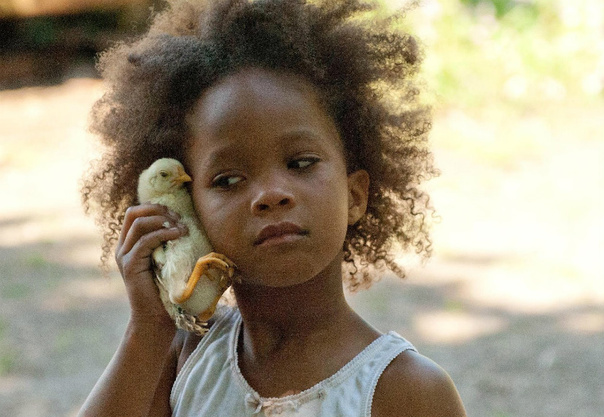
Watch Beasts of the
Southern Wild by receiving the flow of impressions that make up this movie.
Impressions of a young girl’s flights of imagination, where ancient aurochs,
freed from being frozen in melting ice cliffs once again roam the earth; of
depictions of poverty so artful as to become grindingly awful; of a world
surrounded by water that is both full of bounty and of pent up power that
unleashes floods of destructive power; impressions of houses and boats so
richly imagined as to be almost iconographic; of remnants of old stories, based
on obscure symbols that though fragmentary have the power to shape lives,
hopes, and fears; of a story where the myriad details of life are shown to have
dignity while being inseparably connected to the whole of creation, both seen and
unseen. Most of all, receive the impression of looking at reality through the
eyes of an irrepressible young girl for whom life is lived with playful
abandon, where joy is real along with pain, and where death is the interruption
that is the final enemy.

I would find it difficult to write discussion questions for Beats of the Southern Wild because I can
imagine that a discussion of the film could touch on almost everything. Even at
its most surrealistic, this is a profoundly human story, revealed on the screen
with such visual power that its images will forever shape our imaginations.
Watch and discuss it with friends: you won’t know where the conversation is
headed, but chances are it’ll be somewhere meaningful.


When despair is
realism
Lars von Trier, the Danish filmmaker, has recently been in
the news for controversial comments surrounding his film Melancholia that resulted in the directors of the 2011 Cannes Film
Festival declaring him persona non grata.
In 2000 von Trier’s Dancer in the Dark,
starring Icelandic musician Bjork won the Cannes Festival’s highest prize, the
Golden Palm (Palme d’Or). Melancholia had been nominated for the Palme d’Or and won the best actress
award for Kirsten Dunst in her role as Justine, the troubled woman whose story
is central to the plot.
Melancholia is a
simple yet devastating story. Imagine that a beautiful blue planet is hurtling
towards the earth at a speed so great we can watch the blue sphere grow ever
larger in the sky. Imagine that a dysfunctional family gathers to celebrate the
wedding of a daughter who has long struggled with bouts of clinical depression.
Imagine that in this world the possibility of hope is limited to the findings
of science—which mistakenly has issued assurances that no collision is likely.
Imagine how this story will unfold when it is clear that despair is nothing
less than the most realistic perspective possible. “The earth is evil,” Justine
says. “We don’t need to grieve for it. No one will miss it. Life is only on
earth, and not for long.”

It is insufficient to dismiss von Trier here as simply
trying to make a provocative movie. It is true that he has not shied away from
making provocative films, as Dogville
(2003) and Breaking the Waves (1996)
prove. Still, I think more is at stake here. From reports I have read von Trier
has suffered bouts of serious depression himself and his childhood is something
I would wish on no one, leaving him with phobias that haunt him in adulthood.
And he is an artist with his finger posed on the pulse of a world echoing with
the triumphant voices of those who claim that facing down the abyss of
meaninglessness with no hope that anything lies behind death is somehow
significantly courageous. On second thought, that is courageous—futile, but
courageous. As the film’s tagline puts it, “It will change everything.”
Not everyone should watch this film—it is a dark story,
unrelenting in making us face the reality of death in a world without meaning.
Unlike so many films that show the moment of apocalypse with a cacophony of
violence so extreme we must avert our eyes, von Trier invites us to watch to
the end. Planets of breathtaking beauty meet in the immensity of space and
dissolve in a flash of brilliant light. And the three characters we have come
to care about sit together, eyes closed, hands clasped, facing the inevitable
with signs of love that though real are insufficient to change the ending.

Melancholia is
worth watching if you are able to watch dark films. Lars von Trier is a master
at his craft, and the film is an example of cinema at its best. Von Trier
touches on themes with a brutal honesty we dare not evade if we take seriously
the things that matter most.
Taken on its own terms, Melancholia
should drive Christians to some serious reflection. Yes, thankfully the
resurrection provides us with a hope sufficient for even the threat of death
and apocalypse. But how do we express our hope so that it does not seem feeble
at a time when science boasts that reality can be explained without reference
to God or miracles? How is it possible to appeal to the historic fact of
Christ’s resurrection in a way that gives it sufficient philosophical substance
as well as imaginative power? And what can we point to in the way we live, day
by day, that reveals the animating force of hope to radically shape our
thinking, feeling and doing?

Melancholia credits:
Starring:
Kirsten
Dunst (Justine)
Charlotte
Gainsbourg (Claire)
Kiefer
Sutherland (John)
Cameron
Spurr (Leo)
John Hurt
(Dexter)
Charlotte
Rampling (Gaby)
Stellan
Skarsgård (Jack)
Director: Lars von Trier
Writer: Lars von Trier
Producers: Peter Garde & others
Cinematography: Manuel Alberto Claro
USA, 2011; 136 minutes
Rated R (graphic nudity, sexual content and language)

Charlie Fineman (played superbly by Adam Sandler) has been ambushed by the brokenness of the world. An orphan, the aunt who raised him died just prior to his marriage. Then, after a decade of marriage and three lovely daughters (nine, seven, and five), Charlie’s family perished in one of the airplanes that were flown into the World Trade Center on September 11, 2001. Overcome by the crushing burden of his grief, Charlie has withdrawn into a world where he does not need to remember, haunted by the pain. Serendipitously one day Alan Johnson (played by Don Cheadle) runs into him—they had been roommates in dental school—and a renewed friendship is launched.
Reign Over Me is remarkable for several reasons. It faces the horror of death with a rare honesty. It accurately depicts the brokenness that results when someone is overwhelmed by that horror, unable to find healing in his grief. Without sentimentality—everyone in this film has been touched by brokenness—Reign Over Me shows how we flourish as individuals only in community, in friendships that share all of life for blessing and for curse. And it reveals the true costliness of community and friendship. Opening our homes and lives in warm hospitality always extracts a toll en route to shalom.
For Christians Reign Over Me raises important questions. Are we willing to follow Christ in paying the necessary cost to achieve real community in a broken world? Are we willing to walk with someone for the long haul, rather than walking away if healing hasn’t occurred in six months? Do we see and treat people like Charlie, deeply disturbed people, as creatures of wonder who are made in God’s image? Are we the sort of people that those who are hiding deep secrets of regret and hurt are drawn to us because they can sense we are safe?

Alexandra Fuller grew up in Africa, in Rhodesia until that nation’s savage civil war forced most white families to flee the land that was renamed Zimbabwe. Years later she returns to travel from Zambia, where her hardscrabble parents still live, across Zimbabwe into Mozambique with K, a soldier who had fought in the bush in Rhodesia’s army. He is half-mad from his memories, by the atrocities perpetrated by both sides, and by the unspeakable loss inflicted not only on his soul but on the blood-soaked land and its displaced, poverty-stricken tribal peoples.
Fuller’s book, Scribbling the Cat: Travels with an African Soldier (Penguin, 2004) is a memoir of a shared humanity and great poignancy, of tragedy and loyalty, of God’s presence in lives haunted by demons.
“And this,” said K as he stepped into the roofless house, “is where we’ll live one day. I’ll finish building it soon. I have to get the farm going a bit more first, though. But what do you think?”
I wondered who “we” was, but I didn’t ask. Instead I said, “It’s lovely.”
“Look,” said K, “it’s all set up for books. Shelves here, and here. Maybe you could put ornaments on this shelf. This is the kitchen. See? A view of the mountain out the window.” He turned to me and I can describe the look on his face only as transported. “I don’t think,” he said, “that God is going to have me make this journey alone. He will send me a woman when the time is right.”
A blue-headed lizard scampered up the wall where the larder shelves would be one day and one of the dogs darted after it, barely catching the end of its tail, which sloughed off and wiggled hysterically on the cement-dusted floor.
“She’ll have to be a very special woman,” said K, softly and looking at me.
“Yes,” I said.
And then, maybe it was a trick of the rain-softened light, but I saw K’s face fold with such exquisite torment that my heart turned over for him.
He said, “There’s been so much destruction. But I’ve learned so much now. I’ve really learned about love.” K’s lips grew fleshy. “I would nurture a woman. She would be the head of the family now. I wouldn’t have to dominate her. I would put everyone else first. I would come last in the family. This is the order: first God, then my wife, then my children, the dogs, the servants… I would be last. I just want to share this”—he gestured to the house, the garden, the slow-churning river—“with someone.”
I looked away from the house and saw that three fishermen had paddled their canoes around the bend in the river. The evening had brought a kind of careless, extravagant beauty to the world. The sky was rinsed various shades of blue and pink and was scattered with ripped, high clouds. The sun, catching, itself in the trees on the far bank, bled red and gold across the water. Peace Mountain and the distant escarpment were softened in a dying light. From the village opposite K’s farm, blue clouds of smoke from cooking fires tugged into the evening sky. It was the time of day when the confusion of color, the churn of cooler air supplanting the heat of the day, the miracle of the journeying river—everything about being alive—seemed more improbable and fleeting and precious than usual. [pp. 62-63]

Russell Moore makes an interesting observation in Touchstone (September 2008; p. 16-18). He notes that though in the past churches used to have graveyards associated with them, they seldom do anymore. The old arrangement required believers to be reminded of their mortality as they gathered for worship. Today, he notes, churches tend to be surrounded by asphalt. Rather than being reminded of their mortality, 21st century worshippers gather in a setting that is designed to suggest youth, vitality, and in mega-churches, the bustling activity common to a shopping mall.
I’ve never been part of a church that had a graveyard. On a visit to London, however, I attended St Helen’s Bishopsgate, a vibrant, evangelical Anglican church in the heart of the financial district. There was no graveyard, but the dead were all around us. In the walls of the sanctuary (the building dates back to the 13th century) were crypts, each marked with the name of the Christian buried therein. We worshipped in the presence of the dead. I remember thinking I had seldom experienced a better demonstration of the unity of the Church than that morning.
There are lots of reasons—complex sociological, economic, political, even theological reasons—that churches today do not have graveyards associated with them, as Moore recognizes. Still Moore asks, is it possible we’ve lost something in the process? He suggests we might have lost the sense that all will perish apart from the gospel. “Maybe a cemetery,” Moore says, “would serve as a icon that all our Babels will collapse.” Perhaps the perverse seduction of pride and the tendency to allow the important to be pushed aside by the merely urgent would be lessened with a weekly reminder that we too will soon die. “Find an old graveyard,” Moore suggests, “and walk through it. Walk about and see the headstones weathered and ground down by the elements. Contemplate the fact that beneath your feet are men and women who once had youthful skin and quick steps and hectic calendars.” Perhaps walking past a graveyard would remind us that worship, though properly joyous, is also a serious matter touching on the deepest mysteries of life—and death. “Maybe,” Moore says, “we’d be able to speak more honestly to a people scared to death of death if we offered them and ourselves a visible sign that we, too, know what death is, and that we hate it, too.”
I find these reflections interesting. Interesting for what they tell us about how our world has changed. Interesting for what the changes reveal about life, and about us. And interesting for reminding us that nothing in life is so small as to be without meaning in the world God created.
Moore concludes that, “the graveyard is not just a sign that we haven’t forgotten our dead. It’s a sign that we're just waiting for them—and for ourselves—to hear one last invitation hymn. And when those quiet little mounds begin bursting, with headstones flying about, and a clap of thunder resounds across the sky, then at last it can truly be said, ‘Man, this church is alive.’”
To be Christian means to live in the hope of the resurrection. We don’t have graveyards around our churches anymore to remind us of that. So be it. So, let’s find other reminders and hold on to them for dear life.
(Dr. Moore is Dean of the School of Theology at Southern Baptist Theological Seminary. Image courtesy of stock.xchng)